
Recent articles

Choose your countertop first, then pick a backsplash that lets it lead. A busy granite with lots of movement needs a quiet backsplash: a solid tile in one color pulled from the stone. A calm countertop, like a solid or lightly veined quartz, can handle a backsplash with more pattern or texture. For most Yakima kitchens, glazed ceramic or porcelain tile is the easiest backsplash to live with because grease and splatter wipe right off.
Floors, countertops, and backsplashes are what we do, and the backsplash is usually the last decision in a kitchen remodel. Here is how to make it work with the stone you picked, plus the details that are easy to skip until the tile is already on the wall.
Should you choose the countertop or the backsplash first?
Choose the countertop first. A slab of granite or quartz is the bigger investment and the harder thing to change, and every slab has its own color and movement. Tile comes in far more colors, shapes, and finishes than any stone line, so it is much easier to find a tile that suits your slab than to find a slab that suits a tile.
Once the slab is picked, bring a sample or a clear photo of it when you shop for tile. Holding the two side by side settles more questions in five minutes than an hour of scrolling. If you are still deciding on the stone itself, start with our guide on how to choose a countertop color.
What backsplash goes with busy granite?
Busy granite looks best with a simple backsplash in one color pulled from the stone. Granite with heavy speckling, veining, or color variation is already doing a lot of visual work. A patterned tile next to it fights for attention, and the kitchen ends up feeling cluttered even when it is clean.
Look for the quietest color in the slab, often a cream, gray, or soft tan, and match a solid tile to it. Then let the shape add interest instead of the color:
- Subway tile in a classic offset or a stacked layout keeps lines clean.
- Large format tile means fewer grout lines and a calmer wall.
- A subtle texture or gloss catches light without adding pattern.
What backsplash goes with quartz?
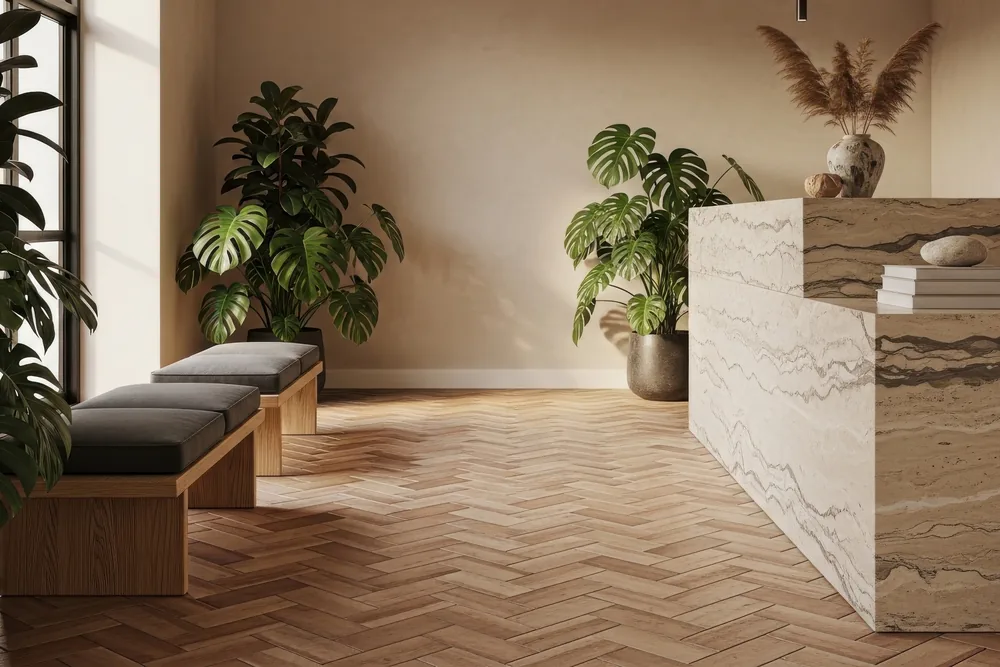
Solid and lightly veined quartz gives you room to use pattern, color, or texture on the backsplash. Because the countertop is calm, the wall can carry the personality. This is where patterned tile, a herringbone layout, a handmade-look tile with color variation, or a deeper color all work well.
Marble-look quartz with bold veining is the exception. Treat it like busy granite and keep the tile quiet, or ask whether a matching stone backsplash makes sense for your slab. Running the same material up the wall gives the cleanest, most continuous look of any option. For a deeper comparison of the two stones, read granite vs quartz.
What is the best backsplash material for a kitchen?
Glazed ceramic or porcelain tile is the best all-around backsplash material for most kitchens. It does not absorb grease or water, it wipes clean behind a range, and it comes in nearly every color, size, and shape. Here is how the common options compare:
- Ceramic and porcelain tile: easy to clean, wide range of looks, and the most practical choice behind a cooktop. See our tile options.
- Glass tile: reflects light and brightens a dark kitchen, but shows water spots and fingerprints more readily.
- Natural stone tile: beautiful and one of a kind, but porous, so it needs sealing to resist stains from cooking oil and sauce.
- Stone slab: the same granite or quartz as your countertop running up the wall. No grout lines at all, which makes it the easiest surface to wipe down. Browse granite and quartz countertops.
How high should a kitchen backsplash go?
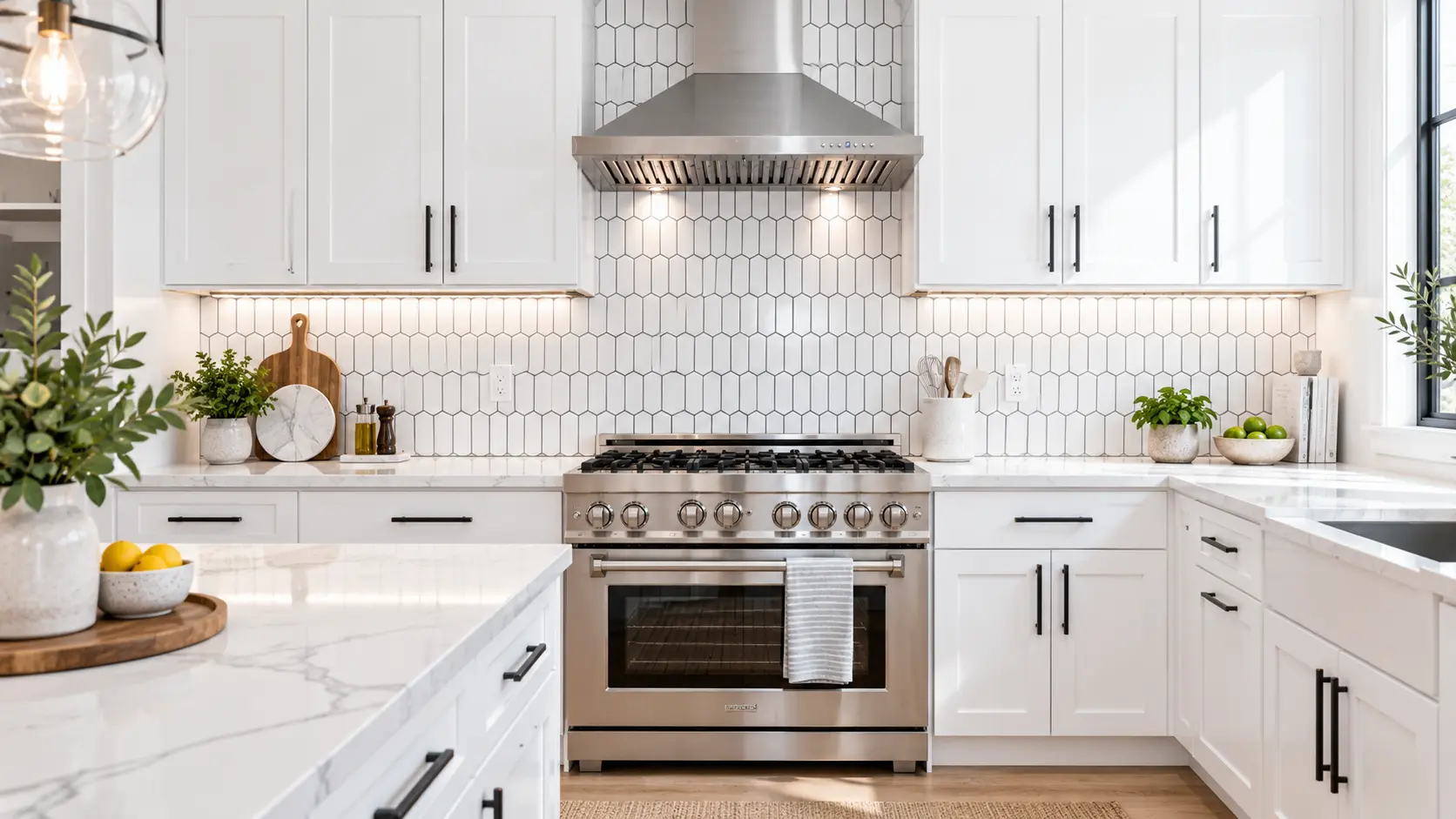
Most kitchens run the backsplash from the countertop up to the bottom of the upper cabinets. A short 4-inch stone splash is the budget option and protects the wall right where water hits, but it leaves painted drywall exposed above it, which is where splatter tends to land.
Behind the range, consider taking the tile all the way up to the hood. That wall takes the most grease and heat, and a full-height section there also gives the kitchen a natural focal point. On walls with open shelving instead of upper cabinets, tile to the ceiling or to a clean stopping line, like the top of a window.
Does grout color matter?
Yes, grout color changes the whole look of a backsplash. Grout that matches the tile makes the wall read as one calm surface. Contrasting grout outlines every tile and highlights the pattern, which suits subway and herringbone layouts but makes busy walls feel busier.
Think about cleaning, too. Bright white grout behind a range will darken over time. A grout one or two shades darker than the tile hides everyday cooking splatter much better.
How to choose a backsplash, step by step
To choose a backsplash, finalize the countertop, pick a color from it, then choose shape, layout, and grout, and check it all in your own kitchen light.
- Finalize the countertop. Pick your slab and get a sample or a clear photo of it.
- Decide who leads. If the stone is busy, the tile stays quiet. If the stone is calm, the tile can carry pattern or color.
- Pull a color. Choose one tone from the slab, or a neutral that sits comfortably next to it.
- Choose a shape and layout. Subway, large format, herringbone, stacked, or patterned, depending on how much movement you want.
- Pick the grout. Matching for a calm wall, contrasting to show off the layout, and a shade darker anywhere near the range.
- Check it in your light. Take tile samples home and hold them against your cabinets and countertop sample, morning and evening.
Why it helps to have one team do the countertops and the backsplash
The backsplash goes in after the countertops are set, so the two jobs depend on each other. When different companies handle them, you are coordinating two schedules and hoping the tile setter's start date lines up with the countertop install.
We fabricate granite and quartz in our own shop, and every installer works directly for our store. We never use subcontractors. That means the people who set your countertop and the people who tile your backsplash work for the same company, on one schedule, with one person to call if anything needs attention. It is part of our full-service installation, and it starts with a free in-home measurement.
The honest part: what a backsplash cannot fix
A backsplash can tie a kitchen together, but it cannot rescue a countertop that clashes with the cabinets. If the slab and the cabinets already fight, the right backsplash is usually the plainest one, chosen to stay out of the way. Adding a bold tile to bridge the gap almost always makes it worse.
Trends are the other trap. A tile you love on a social media feed this year can date a kitchen quickly. If you want something bold, put it in a smaller area, like the wall behind the range, and keep the rest simple. It is the easier choice to live with, and the easier one to update later.
See tile and stone side by side in Yakima
The fastest way to choose is to hold your countertop sample next to real tile. Visit our showroom at 713 South 1st Street in Yakima, Monday through Friday 9 to 5 and Saturday 9 to 4, or call (509) 823-1060 to schedule a free in-home measurement. We install backsplashes, countertops, and floors across the Yakima Valley and Ellensburg; see the communities we serve.
Frequently asked questions
Should a backsplash be lighter or darker than the countertop?
Either works as long as the two contrast clearly or match closely. A light backsplash with a dark countertop brightens the kitchen, while a darker tile with a light countertop adds depth. The look that tends to fail is two tones that are close but not quite the same.
What backsplash goes with busy granite countertops?
A simple, solid tile in one color pulled from the granite. Keep the pattern in the stone and let the tile add interest through shape, like subway or large format, rather than color or print.
Is tile or stone better for a kitchen backsplash?
Glazed ceramic or porcelain tile is the most practical choice for most kitchens because it resists grease and cleans easily. A stone slab backsplash that matches the countertop has no grout lines and gives the cleanest, most continuous look.
Should the backsplash go all the way to the ceiling?
Not usually. Most kitchens run tile from the countertop to the bottom of the upper cabinets. Going to the ceiling makes sense on walls with open shelving or no upper cabinets, and behind a range hood.
Do you install the countertops before the backsplash?
Yes. The countertop goes in first so the backsplash can sit directly on top of it with a clean joint. Having one company handle both keeps the two installs on a single schedule.
.webp)