Recent articles

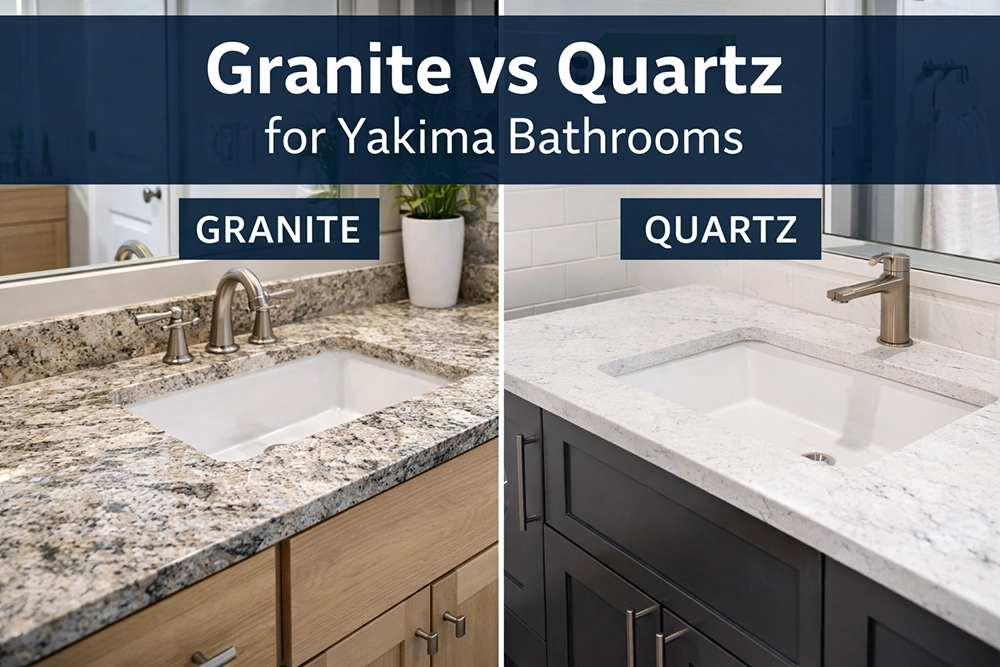
For most Yakima bathrooms, quartz is the easier choice and granite is the more characterful one. Quartz is non-porous, never needs sealing, and shrugs off stains and bathroom humidity with almost no upkeep. Granite is a natural stone with one-of-a-kind veining and excellent heat resistance, but it needs resealing every 1 to 3 years. Both last for decades when fabricated and installed well, so the real decision comes down to maintenance, look, and budget. You can see full slabs of both on our stone countertops page.
Granite vs quartz for Yakima bathrooms at a glance
Here is the quick comparison before the details.
| Factor | Granite | Quartz |
|---|---|---|
| Material | Natural stone | Engineered quartz and resin |
| Sealing | Reseal every 1 to 3 years | Never needs sealing |
| Stain resistance | Excellent when sealed | Excellent, non-porous |
| Heat resistance | Excellent | Good (avoid direct high heat) |
| Look | Unique natural veining | Consistent and uniform |
| Best for | Natural character | Low maintenance, modern look |
Which is more durable in a bathroom, granite or quartz?
Both are highly durable in a bathroom; they simply handle wear differently. Granite is a natural stone that is very hard and heat resistant, and once sealed it stands up to moisture well. Quartz is engineered from natural quartz bound with resins, which makes it non-porous, so it resists stains and bacteria without any sealing. For a busy family bathroom, quartz gives you worry-free performance. For a homeowner who wants natural stone, granite holds up for decades with basic care.
Does granite or quartz need less maintenance?
Quartz needs less maintenance. Because it is non-porous, it never requires sealing and wipes clean with mild soap and water. Granite needs periodic sealing, and most Yakima homeowners reseal every 1 to 3 years depending on use. Sealing is simple, but if low upkeep is your goal, quartz is the more convenient surface. If you like natural stone and do not mind occasional sealing, granite is still an excellent choice. For granite owners, our guide on how to care for granite countertops in Yakima covers the routine.
Which looks better, granite or quartz?
It comes down to the look you want: granite for natural character, quartz for a clean and uniform finish. Granite patterns are formed by nature, so no two slabs match, which makes it a striking focal point in a bathroom. Quartz offers consistent color and veining, which suits modern bathrooms with sleek cabinetry where you want a predictable, controlled look. In our Yakima showroom, homeowners are often surprised how different the same slab looks under real lighting compared to online photos. If you are still weighing colors, our guide on how to choose a countertop color can help.
Is granite or quartz more expensive?
Neither is reliably cheaper; price depends more on the specific slab than on the material. Granite pricing follows rarity and movement in the stone, so common slabs are very competitive while exotic ones cost more. Quartz pricing tends to be more consistent across styles. When you compare, look at the total installed cost, including fabrication, edge details, and thickness, not just the slab price. To get real numbers for your bathroom, call 509-823-1060 for a free measurement and estimate.
Which should you choose for your Yakima bathroom?
There is no universal winner. Choose granite for natural character, or quartz for low-maintenance consistency.
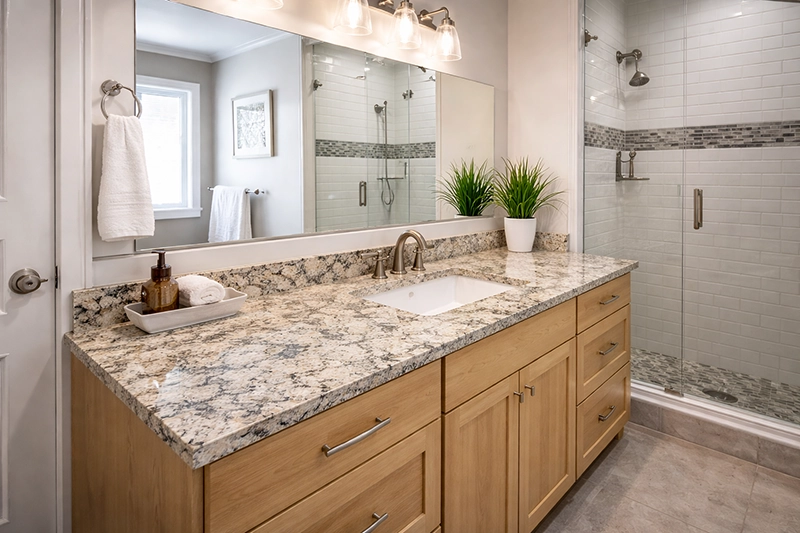
Choose granite if you:
• Love natural, one-of-a-kind patterns
• Do not mind sealing occasionally
• Want organic character and strong heat resistance
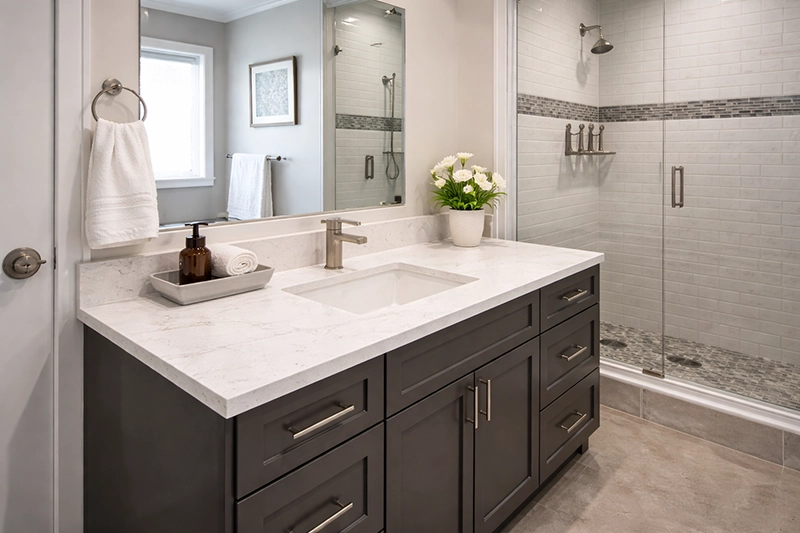
Choose quartz if you:
• Prefer the lowest maintenance
• Want consistent patterning and color
• Like a sleek, modern look
Both are excellent when fabricated and installed properly.
Why installation matters as much as the material
The best slab still underperforms if it is fabricated or installed poorly. Stone countertop performance depends on proper support, seam placement, and edge finishing. Our in-house team cuts and fabricates stone locally rather than relying on subcontractors, which keeps quality control consistent. See how we handle it on our services page.
See granite and quartz slabs in our Yakima showroom
The best way to decide is to see full slabs in person under real light. Browse manufacturer sites for inspiration, and when you find something you like, call 509-823-1060 and we will check availability in our showroom or order it directly from the manufacturer. You can also schedule a free in-home estimate. Family owned, with free measurement and local installation.
Frequently asked questions
Is granite or quartz better for a bathroom?
Quartz is better for most bathrooms because it is non-porous and needs no sealing, so it handles humidity and daily use with minimal upkeep. Granite is the better pick if you want natural, one-of-a-kind stone and do not mind resealing every 1 to 3 years.
Does quartz need to be sealed in a bathroom?
No. Quartz is engineered and non-porous, so it never needs sealing. Granite is porous and should be resealed every 1 to 3 years to keep it resistant to moisture and stains.
Is granite or quartz more expensive for a bathroom vanity?
It depends on the slab, not the material. Common granite and standard quartz land in a similar range, while rare granite and designer quartz cost more. Compare total installed cost, including fabrication and edges, rather than slab price alone.
Which lasts longer, granite or quartz?
Both last for decades when installed properly. Granite is a little more heat resistant, while quartz resists stains better and needs no sealing. In a bathroom, either will outlast most other remodel choices.
Can you put quartz or granite in a small bathroom?
Yes. Both work well on vanities of any size, and a remnant slab can make either material very affordable for a small bathroom. Bring your measurements to our Yakima showroom and we can help you find a slab or remnant that fits.