
Recent articles

The countertop that works in a commercial building is the one that survives being cleaned three times a day by someone who does not own it. Quartz is the strongest all-around choice for offices, reception areas, and restrooms, because it is non-porous and takes daily disinfecting without breaking down. Granite is the better pick where heat is involved or where a business wants natural stone with real character. Laminate is cheaper on day one and is the material that gets replaced first, usually within three to five years in a space that sees public traffic.
What countertop material is best for a commercial space?
Quartz, for most rooms. It is engineered stone, which means it has no natural pores for water, coffee, soap, or disinfectant to soak into. In a building where the cleaning happens on a schedule and nobody is being gentle, that single property does more work than any other spec on the sheet.
Granite comes second and wins in specific spots. It handles direct heat better than quartz, so it belongs anywhere a hot pan or a coffee urn gets set down without a trivet. It is also the choice when a business wants a surface that reads as natural stone, because every slab is different and none of it looks manufactured.
Solid surface shows up in a lot of commercial specs and it has one real advantage: damage can be sanded out and repaired in place. The tradeoff is that it scratches and scorches more easily than either stone, so it trades durability for repairability. We work in natural stone and quartz, so if a project is specified in solid surface we will tell you that up front rather than quote something we do not fabricate.
What should go on a reception or transaction counter?
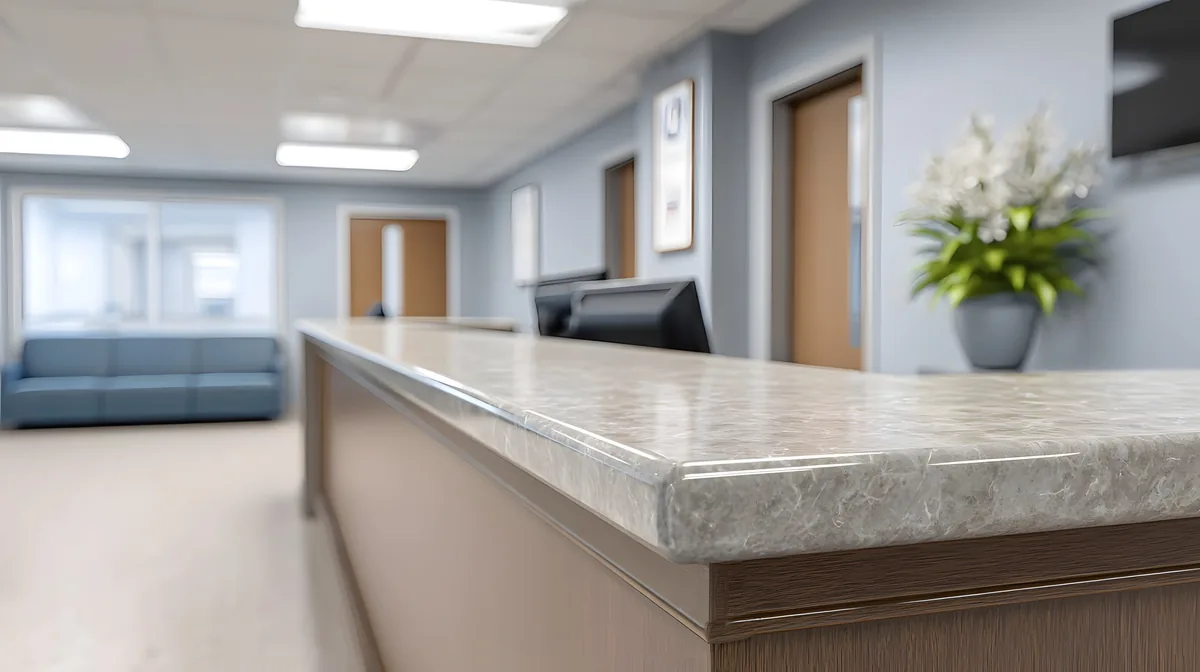
Quartz or granite, and this is the surface where the decision shows most. The reception counter is the first thing every client, patient, parent, delivery driver, and inspector touches when they walk into your building. It takes elbows, clipboards, keys, phones, and wet umbrellas all day long.
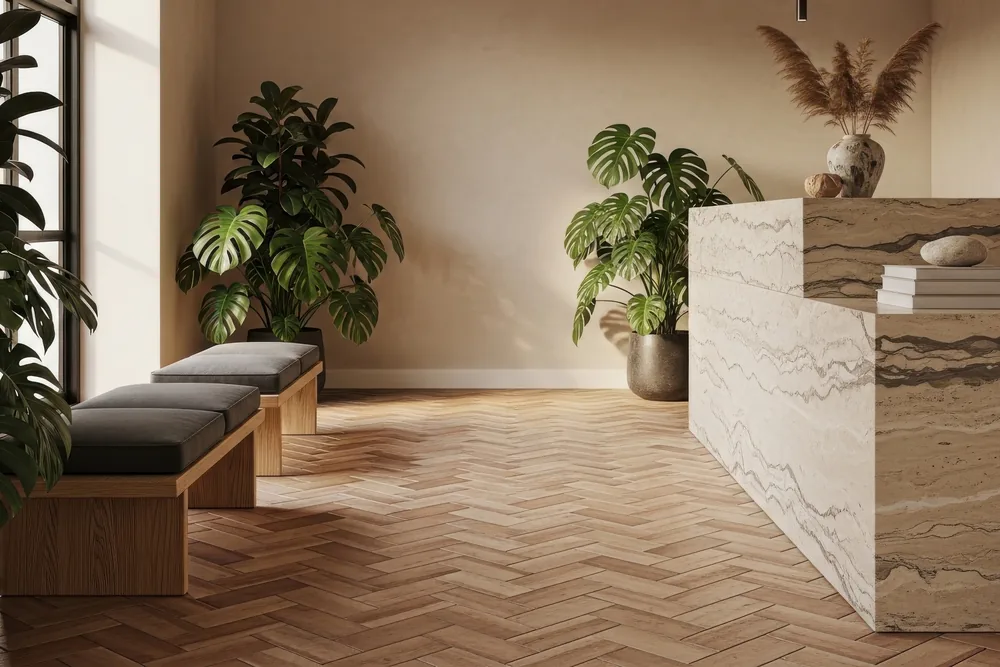
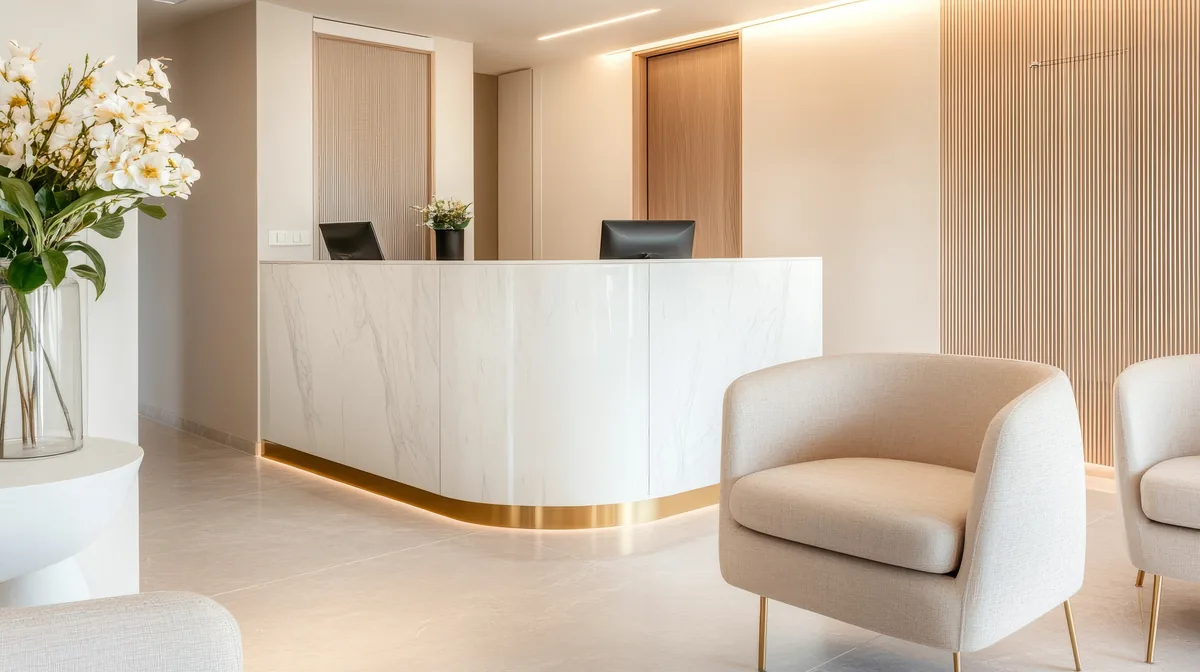
A chipped laminate edge at the front desk is read as a signal about the whole operation before anyone says a word. Stone does not chip at the edge the way a laminate seam does, and a full slab front like the one below turns the desk itself into the design element instead of something to be dressed up later.

One practical note on transaction counters. If the counter has a raised transaction ledge, that ledge and the working surface below it are two separate pieces of stone with a visible joint. Plan the slab so the veining runs continuously across both, or accept that the joint will be obvious. That is a fabrication decision, not a material decision, and it is the kind of thing that gets missed when the stone is ordered as a cut-to-size item from out of the area.
What holds up in an office breakroom?
Granite or quartz, and the breakroom is usually the easiest upgrade in the building to justify. Break counters take hot pans, coffee spills, microwave splatter, and constant use from people who are on a fifteen minute clock and are not being careful. It is also one of the few surfaces in a commercial building that exists purely for the staff, which makes it a visible investment in them.
If your breakroom has a coffee station, go granite under the machine or add a granite section. Repeated heat cycles from a carafe plate will eventually mark a quartz surface, since the resin binder in engineered stone has a lower heat tolerance than natural stone does.
What countertop works in a commercial restroom?
Quartz, without much debate. A commercial restroom vanity is wet constantly, cleaned with harsh chemicals daily, and leaned on and sat on by people who are not thinking about the countertop. Non-porous matters more here than anywhere else in the building.
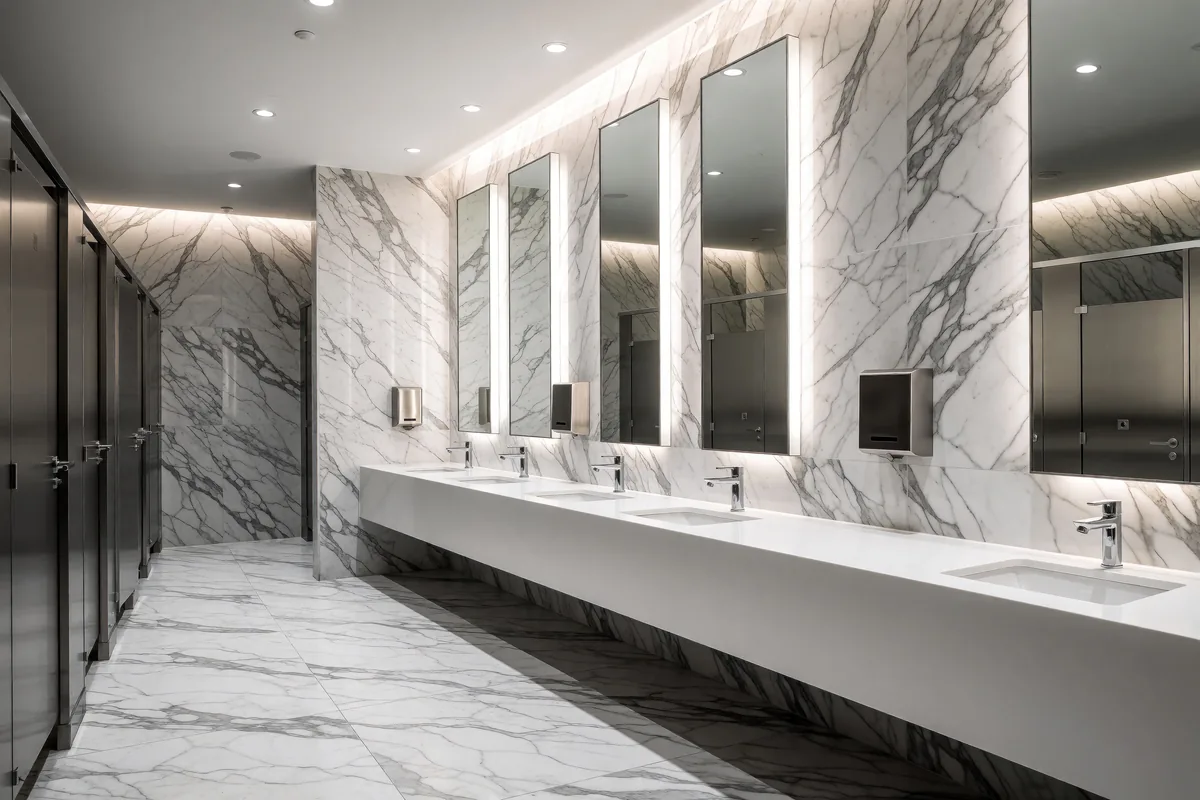
Laminate vanities in public restrooms swell at the seams and delaminate around the sink cutout, usually starting at the back edge where water sits. Once that starts it cannot be repaired, only replaced. Natural stone works too, but granite in a restroom needs sealing on a schedule, and a maintenance task that depends on somebody remembering is a maintenance task that does not happen.
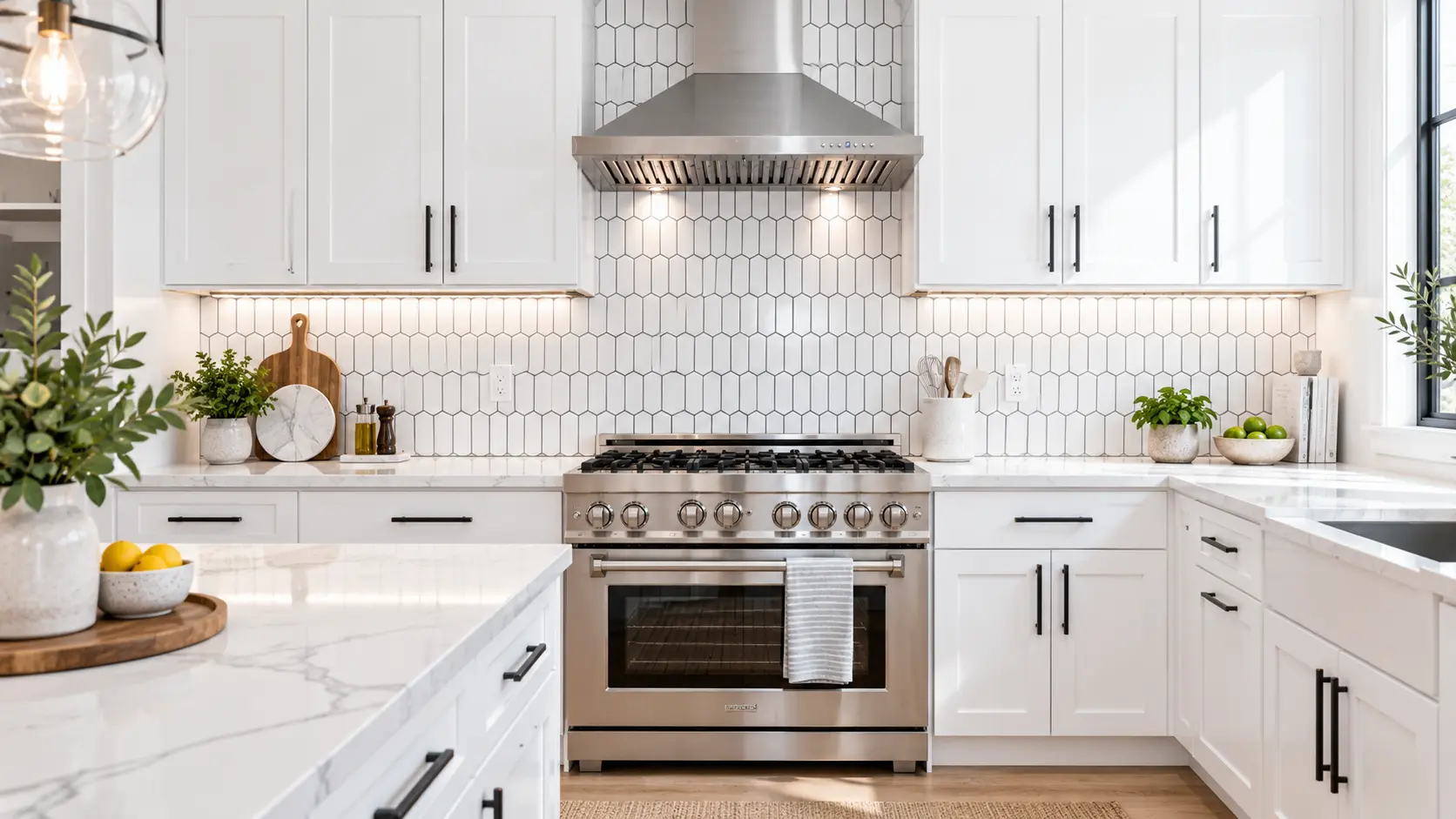
Specify an undermount sink and a coved or eased edge. The gap around a drop-in sink rim is where the grime collects, and it is the first thing anyone notices about a restroom counter. A long run made from as few pieces as possible, like the one above, also cuts down the number of joints that have to be sealed and cleaned.
Quartz or granite for a business?
Quartz for anything wet, public, or cleaned aggressively. Granite for anything hot, and for spaces where natural stone is part of the impression you want to make.
- Quartz: non-porous, never needs sealing, consistent color and pattern from slab to slab, easier to match if you expand later. Lower heat tolerance.
- Granite: handles heat directly, every slab is unique, extremely hard. Needs periodic sealing, and pattern consistency across a long run takes planning.
For a longer comparison of the two in a wet environment, we wrote up granite versus quartz for bathrooms, and most of what applies to a home bathroom applies harder to a commercial restroom.
The honest part: where laminate actually fails
Laminate is not a bad material. It is the wrong material for a surface the public touches, and businesses buy it anyway because the quote is half the price. Here is where the money comes back out.
It fails at the seams first, wherever water sits. Then at the front edge, where the thin decorative layer chips off and exposes the particleboard core underneath. Then around any sink cutout. None of it is repairable, so a failure means a replacement, which means a second round of demo, a second round of downtime, and a second invoice.
A stone counter that lasts twenty years against a laminate counter replaced twice in that span is usually a wash on total cost and a clear win on the four weeks of disruption you did not have. Where laminate genuinely makes sense: back-of-house work surfaces nobody sees, storage rooms, and temporary spaces. We do not sell it, and we will say so.
Why the floors and the countertops should be one job
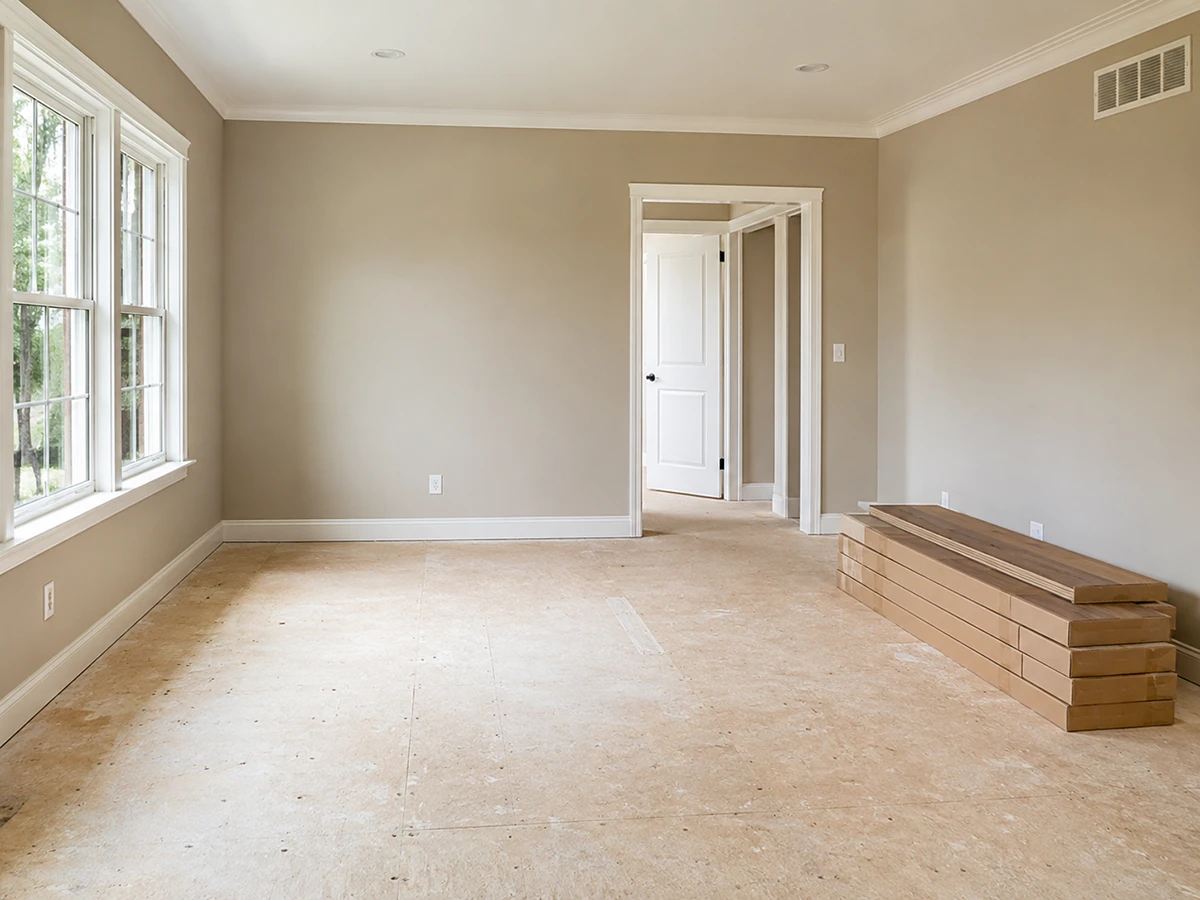
Two trades in a working building means two schedules, two crews to let in, two sets of protection to lay down, and two different companies to call when something is wrong. Splitting them is how a straightforward remodel turns into six weeks of partial closure.
We fabricate granite, quartz, and marble in our own shop and every installer works directly for our store, so a building that needs new commercial flooring and new countertops runs on one schedule with one company answering for all of it. We work nights, weekends, and early mornings so your doors stay open while it happens.
It matters for the look, too. Floor and stone get chosen together or they get chosen twice, and the second version rarely relates to the first. A warm wood-look floor under a veined stone desk is a decision somebody made on purpose.
How the free measurement works for a business
Same process as a home, scaled up, and there is no charge and no obligation attached to it.
- Call or stop in. Call (509) 823-1060 or come to the showroom at 713 South 1st Street in Yakima. Tell us which rooms and how many buildings.
- We come measure. Real measurements on site, room by room. Existing commercial casework is rarely square and almost never matches the drawings.
- We template the stone. Templating happens after any cabinet or base work is set, because the stone gets cut to the space as it actually exists.
- You get a written quote. Material, fabrication, tear-out and haul-away, install, and edge profile, itemized, in a form you can hand to a purchasing office or a board.
- You decide when. No pressure and no expiring offer. One breakroom counter or an entire building, the measurement and the quote are free either way.
Talk to us about your building
We handle commercial flooring and countertops for businesses across Yakima, Selah, Union Gap, Ellensburg, Toppenish, Sunnyside, and Grandview. Our crews have worked in churches, movie theaters, Job Corps, schools, offices, and rental properties around the valley. Glenn, one of our owners, runs the commercial side and will walk the building with you.
Call (509) 823-1060 or schedule a free measurement. You can also read our commercial flooring guide for Yakima businesses or see the best commercial flooring by industry.
Frequently asked questions
What is the best countertop material for a commercial office?
Quartz for most surfaces, because it is non-porous and stands up to daily disinfecting without sealing. Granite where heat is involved, such as a breakroom coffee station or anywhere hot pans get set down.
How long do commercial countertops last?
Quartz and granite routinely last twenty years or more in a commercial setting with normal cleaning. Laminate in a public-facing space typically needs replacing in three to five years, sooner around sinks.
Do quartz countertops need to be sealed?
No. Quartz is engineered with resin and has no pores to seal, which is why it suits buildings where maintenance depends on a rotating cleaning crew. Granite does need periodic sealing.
Can countertops be installed without closing the business?
Usually yes. Because our installers are employees rather than subcontractors, we can schedule evenings, weekends, or early mornings and hold to it. Most businesses do the work in phases so one area stays open.
Do you do commercial countertops and flooring together?
Yes, and it is the reason to use one company. We fabricate the stone in our own shop and install the flooring with our own crew, so both go in on a single schedule with one point of contact. Call (509) 823-1060 for a free measurement.
.webp)