
Recent articles
Engineered Hardwood vs Solid Hardwood: What Yakima Homeowners Need to Know
Hardwood flooring remains one of the most sought-after upgrades for Yakima homes. It adds warmth, character, and long-term value that few other flooring types can match. But when you start shopping for hardwood, you quickly run into a choice: engineered or solid?
Both are real wood. Both look beautiful. But they are built differently, perform differently, and suit different situations. This guide breaks down the key differences so you can make a confident decision before visiting our showroom.
What Is Solid Hardwood Flooring?
Solid hardwood is exactly what it sounds like: a single piece of solid wood, typically 3/4 inch thick, milled from one species of timber. It comes in two forms at our Yakima showroom.
Prefinished hardwood arrives with the stain and finish already applied at the factory. It installs faster and you can walk on it immediately.
Unfinished hardwood is installed raw and then sanded, stained, and sealed on-site. This gives you complete control over the final color and finish but adds time and labor to the project.
Key advantage: Solid hardwood can be sanded and refinished multiple times over its lifespan, often 5 to 7 times or more. A well-maintained solid hardwood floor can last 75 to 100 years.
What Is Engineered Hardwood Flooring?
Engineered hardwood has a real hardwood veneer on top (typically 2 to 6 mm thick) bonded to multiple layers of plywood or high-density fiberboard underneath. Those cross-layered backing materials give engineered hardwood a significant structural advantage over solid wood.
Key advantage: The layered construction makes engineered hardwood far more dimensionally stable than solid wood. It resists expansion and contraction caused by temperature and humidity swings, which is a meaningful benefit in Yakima's climate where summers are hot and dry and winters are cold and damp.
Climate and Performance: Why This Matters in Yakima
Yakima's semi-arid climate with wide seasonal temperature swings creates real challenges for solid hardwood. In winter, heated indoor air dries out, causing solid wood planks to contract and develop gaps between boards. In summer, higher humidity can cause slight expansion.
Engineered hardwood handles these swings significantly better because the cross-layer construction counteracts the wood's natural tendency to move. For homes without humidification systems, or for installations over concrete slabs and radiant heat, engineered hardwood is often the smarter choice.
For more on protecting wood floors during Yakima's toughest season, read our guide on how to protect floors during Yakima winters.
Where Can Each Type Be Installed?
Solid hardwood should only be installed on or above grade (main floor and upper levels). It requires nail-down or staple-down installation over a wood subfloor. It is not recommended for basements, over concrete slabs, or over radiant heat systems.
Engineered hardwood can be installed on any level of the home, including basements. It can be floated, glued, stapled, or nailed down, giving your installation team more flexibility. It also works well over concrete slabs and radiant heating systems.
Appearance: Can You Tell the Difference?
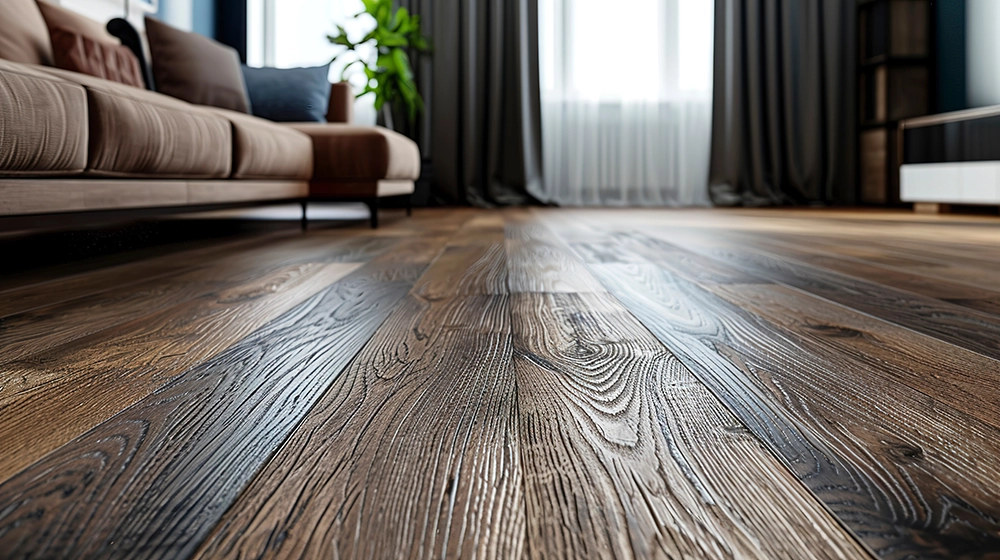
Once installed, most people cannot tell the difference between engineered and solid hardwood by looking at it. Both feature a real wood surface with natural grain patterns and character. The top layer of engineered hardwood is the same species you would get in a solid plank: oak, maple, hickory, walnut, and others.
The visual difference is essentially zero. The difference is what is underneath.
Refinishing and Long-Term Value
Solid hardwood can be sanded and refinished 5 to 7 times or more. This means you can change the stain color, repair deep scratches, and restore the floor to like-new condition multiple times over its lifetime.
Engineered hardwood can be refinished 1 to 3 times depending on the thickness of the top veneer layer. Thicker veneers (4 mm and above) allow for more refinishing cycles. Thinner veneers may only allow a light screen-and-recoat rather than a full sand.
If you are planning to stay in your home for 30+ years and want the option to change your floor color or do full restorations, solid hardwood has the edge here.
Cost Comparison
Material costs for engineered and solid hardwood are comparable in many cases, though the range varies by species and quality. Where the real cost difference shows up is in installation.
Solid hardwood installation typically costs more because it requires nail-down methods, acclimation time, and in the case of unfinished wood, on-site sanding and finishing.
Engineered hardwood installation is often faster and more flexible, especially with floating installations, which can reduce overall labor costs.
For a broader look at flooring costs, check out our Yakima hardwood flooring cost guide.
Which Should You Choose?
Choose solid hardwood if:
You are installing on a wood subfloor on the main or upper level. You want maximum refinishing potential over decades. You prefer unfinished wood so you can custom-stain on site. You are building your forever home and want the longest possible lifespan.
Choose engineered hardwood if:
You are installing over concrete, in a basement, or over radiant heat. You want the look of real hardwood with better dimensional stability in Yakima's climate. You want more installation method options including floating. You want a real wood floor that is more forgiving of humidity and temperature changes.
Still not sure? Our team can look at your subfloor conditions, your home's layout, and your long-term plans and give you a straightforward recommendation. Reach out to schedule a free in-home measurement.
Frequently Asked Questions
Is engineered hardwood real wood?
Yes. The top layer is real hardwood, the same species you would find in a solid plank. The difference is the substrate underneath, which is layered plywood or fiberboard designed for stability.
Does engineered hardwood increase home value like solid hardwood?
Yes. Appraisers and buyers generally treat both as real hardwood flooring. Engineered hardwood adds comparable resale value to solid hardwood in most markets.
Can I install hardwood flooring in my kitchen?
You can, but you need to be mindful of water exposure around sinks and dishwashers. Engineered hardwood handles occasional moisture better than solid. For rooms with heavy water exposure, consider pairing hardwood in the main area with waterproof LVP near wet zones.
What hardwood species are most popular in Yakima?
Oak (white and red) is by far the most popular due to its durability, grain character, and availability. Hickory is a close second for homeowners who want a harder, more rustic look. Stop by our showroom to see the full range in person.
Does All American Discount Flooring have specials on hardwood?
We frequently run promotions on hardwood flooring. Visit our specials page for current deals, and remember that military, veterans, teachers, and first responders receive year-round discounts.
See Hardwood Flooring Samples at Our Yakima Showroom
The best way to compare engineered and solid hardwood is side by side in person. Visit us at 713 S. 1st Street in Yakima to see and feel the difference, compare species and stain colors, and get a free estimate for your project.
Contact us today or stop by during showroom hours. And for more flooring tips and comparisons, explore our full library of buying guides and articles.